.avif)
10 Most Common CPAP Complaints and How to Fix Them: An Honest Guide for Patients
10 Most Common CPAP Complaints and How to Fix Them: An Honest Guide for Patients
By Kevin Asp, CRT, RPSGT, FAAST
Chief Operating Officer, Lucid Sleep Experts
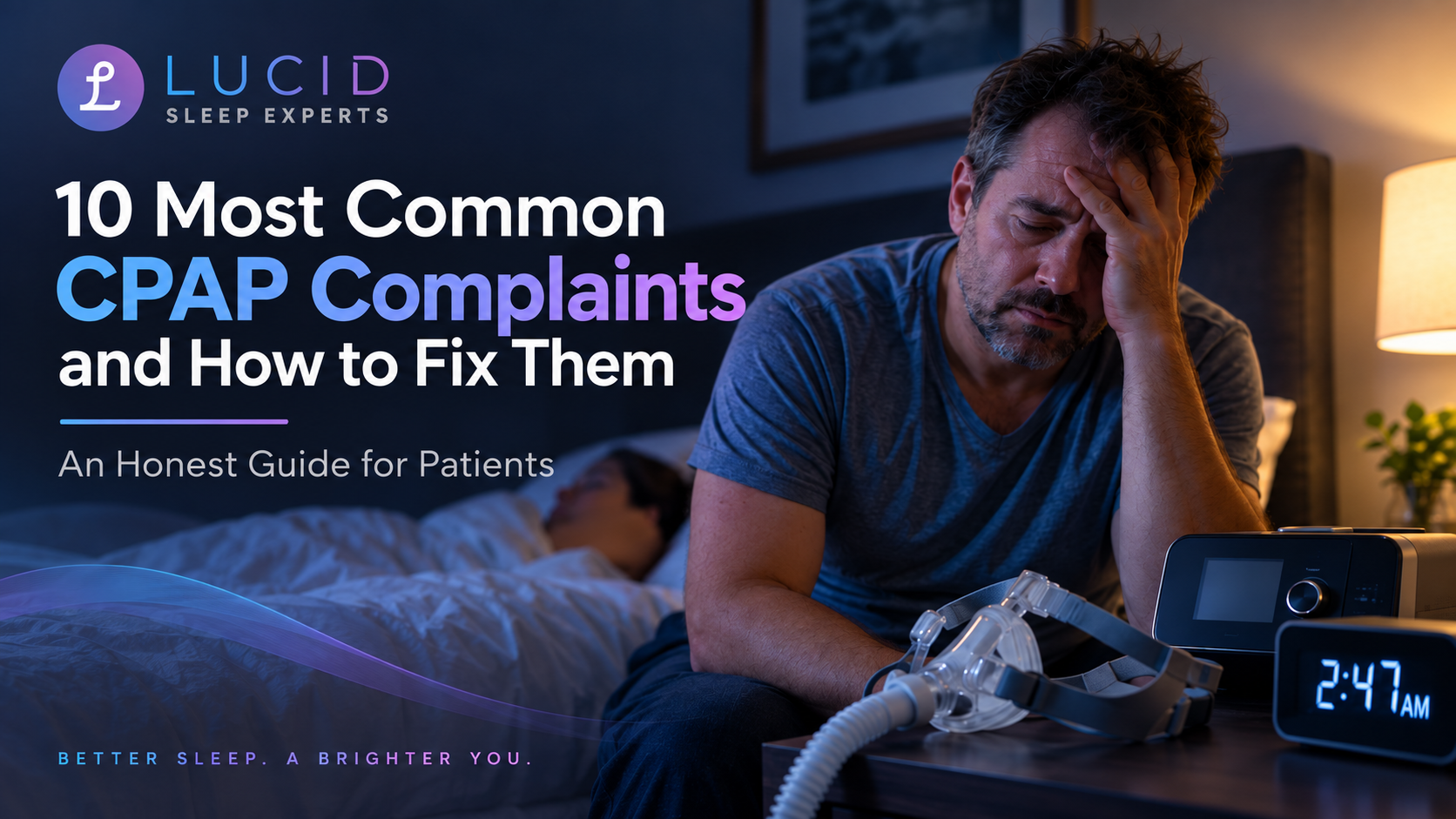
It is 2:47 a.m. You wake up with your mouth so dry your tongue feels glued to the roof of it. The mask has slipped again and cold air is hissing into your eye. Your spouse rolled to the far edge of the bed hours ago. You pull the whole thing off, drop it on the nightstand, and tell yourself you will try again tomorrow.
Tomorrow turns into a week. The machine becomes the most expensive coat rack in the house.
If that scene feels familiar, you are not weak, lazy, or noncompliant. You are dealing with a therapy that works remarkably well for the airway and, for many people, works poorly for the human attached to it. This article is going to be honest with you about that. It will also show you that nearly every CPAP complaint has a fix, and that the people who quietly succeed with CPAP are usually not tougher than you. They just got the right adjustments at the right time.
The truth nobody tells you at the CPAP setup appointment
Continuous positive airway pressure is still the gold standard treatment for obstructive sleep apnea. When it is used consistently, it lowers blood pressure, reduces cardiovascular risk, sharpens daytime thinking, and can dramatically improve mood and energy. None of that is in dispute.
What is rarely said out loud is how many people never get there. Depending on which study you read, somewhere between a third and half of patients who start CPAP are no longer using it regularly a year later. Insurance defines "adherence" as at least four hours a night on at least 70 percent of nights, and a large share of patients fall short of even that modest bar within the first 90 days. The first two to four weeks are where most of the damage is done. Problems that could have been solved with a different mask cushion or a pressure setting change become reasons to quit, and quitting becomes permanent.
The reason this matters is simple. Untreated sleep apnea does not pause while you decide whether you like your mask. Every night off therapy is a night your oxygen levels drop repeatedly, your heart works harder, and your brain never reaches the deep, restorative sleep it needs.
Who is telling you this
I have spent 32 years in sleep medicine as a respiratory therapist and sleep technologist, much of it sitting across from patients who were ready to give up on treatment. At Lucid Sleep Experts, our team of board-certified sleep physicians, sleep-trained dentists, and clinical staff serves San Antonio and Kerrville, Texas, and we have heard every one of the complaints below many times. We have also watched the same patients go from frustrated to thriving once the actual problem was identified.
We are also not a CPAP-only practice. That matters, because it means we have no reason to push you toward a machine if a machine is not the right answer for you. If CPAP can be made to work, we will help you make it work. If it cannot, we will tell you that honestly and talk about alternatives.
If you are in the San Antonio or Kerrville area and your CPAP is winning the nightly battle, schedule a CPAP troubleshooting visit at Lucidtx.com. Bring your mask, your machine, and your complaints. Most of what follows can be fixed in a single appointment.
Now let's get into the list.
Complaint 1: The mask leaks, slides, and leaves marks on my face
This is the most common CPAP complaint by a wide margin, and it is the root cause of several others on this list. Air leaking around the edges of the mask means noise, dry eyes, lower effective pressure, and a strong temptation to overtighten the straps. Overtightening creates red marks, pressure sores across the bridge of the nose, and headaches.
What actually fixes it:
- Get refitted, not just resized. Mask fitting is not a one-time event. Weight changes, facial hair, and even the pillow you use affect how a mask seals. A proper fit should be checked while lying in your normal sleep position with the machine running at your prescribed pressure, not sitting upright in a chair.
- Change the style, not just the size. If a full-face mask keeps leaking at the chin, a nasal pillow or nasal cushion mask may seal far better. If nasal pillows irritate your nostrils, a nasal cradle mask that sits under the nose may be the answer. There are dozens of designs for a reason.
- Loosen, then adjust. A well-fitting mask should seal at moderate strap tension. If you have to crank it down to stop leaks, the mask is the wrong shape for your face.
- Replace cushions on schedule. Silicone cushions lose their seal after roughly one to three months of nightly use. Most insurance plans cover replacements. Use them.
- Try mask liners or a barrier cream if skin irritation persists, and check that you are washing facial oils off both your face and the cushion before bed.
Complaint 2: I wake up with a painfully dry mouth
Dry mouth, or xerostomia, is the second most common CPAP complaint and one of the most underestimated. It is more than an annoyance. Saliva is the mouth's built-in defense system. It buffers acid, washes away bacteria, and protects tooth enamel and gum tissue. When pressurized air moves across the mouth for seven hours a night, that protection disappears. CPAP users with chronic dry mouth are at higher risk for cavities, gum disease, cracked lips, sore throat, and bad breath, and many of them do not connect those dental problems to their sleep therapy.
Dry mouth on CPAP almost always comes from one of two sources: your mouth is falling open during sleep (a "mouth leak"), or the air itself is too dry.
What actually fixes it, in order:
- Fix the mouth leak first. If you use a nasal mask or nasal pillows and your mouth drops open, pressurized air rushes out through your mouth and takes every drop of moisture with it. A chin strap can help some patients. Others do better switching to a full-face mask that covers both nose and mouth. Many patients also find that treating nasal congestion (see Complaint 3) reduces the reflex to mouth-breathe in the first place.
- Turn on heated humidification and use a heated tube. Nearly every modern CPAP has a built-in humidifier. Set it higher than feels necessary, then use a heated hose so the moisture does not condense into water droplets in the tube (the dreaded "rainout"). In dry Texas winters, this alone solves the problem for a lot of people.
- Address the mouth tissue directly. Even with the leak controlled and humidity turned up, some patients still wake with a dry, sticky mouth, especially those who also take medications that reduce saliva (antidepressants, blood pressure medications, antihistamines, and many others). For those patients, a topical dry-mouth product used at bedtime can make the difference between tolerating therapy and abandoning it.
A closer look at Aquoral for CPAP-related dry mouth
Most over-the-counter dry mouth products are water-based rinses, gels, or lozenges. They feel good going in and are gone within an hour, which is exactly why they fail CPAP users. Airflow washes them away before the night is half over.
Aquoral takes a different approach. It is a prescription-only oral spray built on a lipid (oil-based) formulation called oxidized glycerol triesters, or OGT. Rather than adding water to the mouth, it forms a thin protective film over the oral tissues that limits moisture loss and lubricates the mucosa. According to the manufacturer, two sprays provide relief that lasts four to six hours, which lines up much better with a night of sleep than a rinse that lasts sixty minutes. It comes in two small 10 mL spray bottles, requires no mixing or rinsing, and can simply sit on the nightstand.
The company's own CPAP page features a dental hygienist who reports she had abandoned CPAP because of nightly severe dry mouth, tried virtually every product on the market, and was able to return to therapy once she began using two sprays at bedtime. Her account is worth reading because it is candid: she says the dry mouth did not disappear, but it became manageable enough to keep her on treatment. That is a realistic expectation.
A few honest points before you ask for it:
- Aquoral is symptom relief, not a mouth-leak fix. If air is pouring out of your open mouth all night, spray will not stop that. Solve the leak and humidity issues first, then use Aquoral to manage what remains.
- The clinical evidence the company cites comes from a randomized trial in patients with medication-induced dry mouth, not CPAP users specifically. The mechanism is the same (protecting dry oral tissue), and the CPAP testimonial is encouraging, but you should know what the data does and does not cover.
- It requires a prescription. Your sleep physician or dentist can write it, and the manufacturer also offers a telehealth ordering pathway. Ask about cost and insurance coverage up front.
For patients whose dry mouth is the last thing standing between them and consistent CPAP use, a product that lasts through the night is a legitimate tool, and one that a practice combining sleep medicine and dentistry is well positioned to help you evaluate.
Complaint 3: My nose is dry, stuffy, or bleeding
Nasal symptoms are the flip side of the dry mouth problem. Pressurized air drying the nasal lining leads to congestion, sneezing, a runny nose, and in some cases nosebleeds. Congestion then triggers mouth breathing, which triggers dry mouth, and the cycle feeds itself.
What actually fixes it:
- Humidification again. Same fix as above, and it is worth repeating because so many patients never touch the humidifier setting after the initial setup.
- Saline spray or rinse before bed to clear and moisturize the nasal passages.
- Treat the underlying nose. Allergies, a deviated septum, chronic sinusitis, and enlarged turbinates all make nasal CPAP miserable. A nasal steroid spray, an allergy workup, or an ENT evaluation can change everything. If your nose has never worked well, no mask is going to fix that on its own.
- Consider a full-face mask temporarily during allergy season or a cold so you are not forced off therapy every time your nose closes up.
Complaint 4: I feel claustrophobic and panicky with the mask on
This is real, common, and nothing to be embarrassed about. Having something strapped to your face while air is pushed into you can trigger a genuine anxiety response, especially in the first weeks.
What actually fixes it:
- Desensitize during the day. Wear the mask alone, no hose, while watching television for 20 minutes. Then add the hose with the machine off. Then turn the machine on while you are awake and relaxed. Build up over a week rather than diving in on night one.
- Go smaller. Nasal pillows sit under the nose with minimal contact and leave your field of vision completely open. For many claustrophobic patients, this alone solves it.
- Use the ramp feature so pressure starts low and rises gradually as you fall asleep.
- Ask for help if it persists. A few sessions of cognitive behavioral therapy focused on CPAP acceptance have solid evidence behind them and can be arranged through your sleep team.
Complaint 5: The pressure feels like too much, or I can't exhale against it
Some patients feel like they are breathing into a hurricane. Others feel they cannot push air back out. Both are usually settings problems, not proof that CPAP is wrong for you.
What actually fixes it:
- Expiratory pressure relief. Most machines have a setting (called EPR, C-Flex, or similar depending on the brand) that drops the pressure slightly each time you exhale. It is often turned off by default.
- Ramp and auto-adjusting mode. An auto-titrating machine (APAP) delivers only the pressure you need moment to moment rather than a fixed high number all night.
- Have your data reviewed. Your machine records every breath. A sleep clinician can see whether your pressure is truly too high, whether leaks are inflating the numbers, or whether a switch to bilevel therapy (BiPAP), which uses a separate lower pressure for exhaling, would make you comfortable.
Complaint 6: I wake up bloated and gassy
This is called aerophagia, and it happens when pressurized air is swallowed into the stomach instead of going into the lungs. It causes belching, bloating, and abdominal discomfort in the morning.
What actually fixes it:
- Lower the pressure or add exhale relief. Aerophagia is frequently a sign the pressure is higher than you need.
- Fix mask leaks and mouth breathing, which cause you to gulp air.
- Ask about bilevel therapy. When a patient needs a high pressure to keep the airway open but keeps swallowing air, switching to a bilevel device (BiPAP) is sometimes the answer. Bilevel delivers a higher pressure when you inhale and a lower pressure when you exhale, so the airway stays open without the constant force that pushes air toward the stomach. This is a prescription change your sleep physician can make after reviewing your data.
- Sleep with your head slightly elevated, and avoid eating a large meal or drinking carbonated beverages close to bedtime.
- Rule out reflux. GERD and sleep apnea travel together, and treating reflux often improves aerophagia.
Complaint 7: The machine and mask are too loud
Modern CPAP machines are genuinely quiet, often quieter than a bedside fan. When patients report noise, it is almost always the mask, not the machine.
What actually fixes it:
- Stop the leak. A hissing or whistling mask is a leaking mask. See Complaint 1.
- Check the exhalation port. Every mask has a small diffuser vent. If it is clogged or aimed at your partner, it is noisy. Some masks are specifically designed with quieter, more diffused venting.
- Move the machine off the nightstand and onto a lower surface or a soft mat if vibration is the issue, and make sure the filter is clean.
- Replace an aging machine. If your device is more than five years old, newer models are dramatically quieter and are typically covered by insurance on a replacement schedule.
Complaint 8: The hose tangles, my hair is a mess, and my partner is miserable
Tubing gets caught under your body, pulls the mask when you roll over, and yanks you awake. Headgear flattens and tangles hair. And the person next to you feels the cold breeze from your exhalation port all night.
What actually fixes it:
- A hose hanger or hose lift mounted to the headboard keeps tubing overhead and out of the way.
- Top-of-head connector masks route the tube up and over rather than across your chest, which is a game changer for side and stomach sleepers.
- A slimmer hose or a longer one reduces drag.
- A satin or silk pillowcase, or a CPAP-specific pillow with cutouts, protects hair and keeps the mask from being pushed sideways.
- Aim the vent away. Mask venting direction varies by model. If your partner is getting blasted, a different mask solves it.
Complaint 9: Cleaning it every day is a hassle
The honest truth is that most people do not clean their equipment as often as the manual suggests, and most of them are fine. But neglected equipment does contribute to skin breakouts, respiratory irritation, and mask degradation.
What actually fixes it:
- Simplify to a realistic routine. Wipe the mask cushion with a CPAP wipe or mild soap and water each morning (it takes 30 seconds). Rinse the humidifier chamber and let it air dry. Wash the hose and headgear once a week.
- Use distilled water in the humidifier to prevent mineral buildup.
- Skip the ozone and UV sanitizing machines. The FDA has warned they are not proven safe or effective and may damage your equipment. Soap and water works.
- Stay on your replacement schedule. Fresh supplies are easier to keep clean than worn ones.
Complaint 10: I take it off in my sleep, and I still feel tired
Waking up to find the mask on the floor with no memory of removing it is frustrating. So is using the machine faithfully and still dragging through the day.
What actually fixes it:
- Look for the trigger. Patients usually remove the mask in response to a leak, discomfort, dryness, or congestion. Fixing the underlying irritant usually stops the unconscious removal.
- Set a mask-off alert if your machine or app supports it.
- Review the data before assuming CPAP failed. If you are using the machine all night and still exhausted, your sleep team can check whether your residual apnea index is elevated, whether leaks are undermining therapy, or whether pressure needs adjustment. Persistent sleepiness despite good CPAP data may point to a second condition, such as insomnia, restless legs, or a circadian issue, which no amount of CPAP tinkering will fix.
What if you have tried everything and CPAP still isn't working?
Here is where honesty matters most. Some people, after genuine effort and skilled troubleshooting, simply cannot live with CPAP. That is not failure. It is information.
For patients with mild to moderate sleep apnea, and for many with severe apnea who cannot tolerate CPAP, oral appliance therapy is an evidence-based alternative. A custom-fitted device, made by a sleep-trained dentist, gently holds the lower jaw forward to keep the airway open. No mask, no hose, no electricity, no noise. It is not right for everyone, and it works best when the physician who diagnosed you and the dentist who fits the appliance are working from the same chart. That is exactly how Lucid is structured, with sleep physicians and sleep dentists under one roof.
Other options, including positional therapy, weight management programs, and for select patients, hypoglossal nerve stimulation (Inspire), also exist. The point is that walking away from CPAP should never mean walking away from treatment.
Your plan: three steps to a therapy you can live with
- Stop guessing and bring the data. Schedule a visit with a sleep team that will actually look at your machine's leak, pressure, and usage reports rather than just asking how it's going.
- Fix the problems in order. Mask fit and leak first, humidity and nasal health second, then pressure comfort settings, then targeted tools like Aquoral for residual dry mouth. Most patients need two or three adjustments, not a whole new life.
- Set a decision point. Give a properly optimized setup 30 honest nights. If it works, you have solved a problem that affects your heart, your brain, and your relationships. If it does not, you will know it is time to talk seriously about oral appliance therapy or other options, with a team that offers them.
What is at stake
Untreated sleep apnea roughly doubles the risk of hypertension, raises the risk of stroke and heart attack, worsens blood sugar control, and is strongly linked to depression, motor vehicle accidents, and cognitive decline. It also quietly erodes the things that make life good: patience with your kids, energy for your work, closeness with your partner. A CPAP machine sitting unused on a nightstand protects you from none of that.
What it looks like when it works
Patients who get past the first rough month describe the same thing. They wake up before the alarm. They stop needing the 3 p.m. coffee. Their partner moves back to the middle of the bed. Their blood pressure medication gets reduced. They forget the mask is even there.
That outcome is not reserved for people with more willpower than you. It belongs to people who got their complaints taken seriously and fixed one at a time.
If you are in San Antonio or Kerrville, we would like to be the team that helps you get there. Schedule a visit with Lucid Sleep Experts at Lucidtx.com, bring your equipment, and bring every complaint on this list. We will sort out what can be fixed, tell you honestly what cannot, and make sure you leave with a plan.
Leave the Rest to Us.
About the author
Kevin Asp, CRT, RPSGT, FAAST, is the Chief Operating Officer of Lucid Sleep Experts in San Antonio and Kerrville, Texas. A credentialed respiratory therapist and registered polysomnographic technologist with 32 years in sleep medicine, he has operated sleep disorder centers, worked directly with thousands of CPAP patients, and is a Fellow of the American Academy of Sleep Technologists. He contributed a chapter on consumer sleep-tracking technologies to the fourth edition of Fundamentals of Sleep Technology and has written about sleep medicine for many sleep publications.
This article is for educational purposes and does not replace individualized medical advice. Talk with your sleep physician or dentist before changing your CPAP settings or starting any prescription product.