.avif)
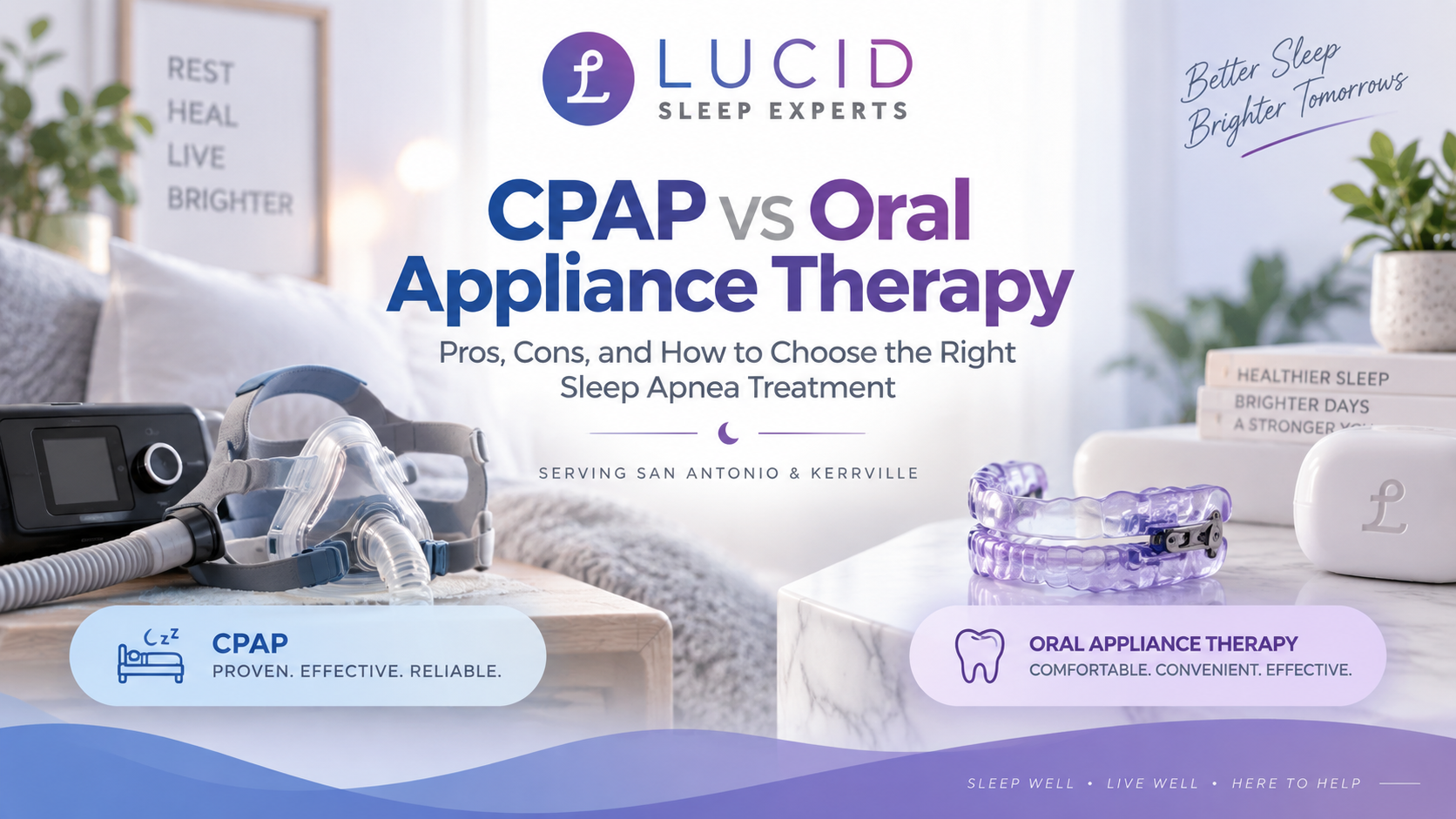
CPAP vs Oral Appliance Therapy: The Pros and Cons of Each Sleep Apnea Treatment
Shana Hansen, MD, Medical Director, Lucid Sleep Experts
You Were Told You Have Sleep Apnea. Now What?
You finally did the sleep study. Maybe your spouse pushed you to do it after years of listening to you snore, or maybe you were tired of waking up feeling like you had not slept at all. Either way, the results are back, and the diagnosis is obstructive sleep apnea.
Then comes the part nobody prepares you for: the treatment conversation.
Someone mentions CPAP. You picture the mask, the hose, the machine humming on the nightstand. You think about your brother-in-law who bought one and has not touched it in three years. Then you hear about oral appliance therapy, a small mouthpiece you wear while you sleep, and you wonder if that is a legitimate treatment or a shortcut that will not really fix anything.
You want to breathe at night. You want to wake up rested. You want to protect your heart, your blood pressure, your memory, and your relationship. What you do not want is to spend months and thousands of dollars on a therapy you cannot live with.
That confusion is not a personal failing. It is the natural result of being handed a diagnosis without a guide. This article is meant to be that guide.
I am Dr. Shana Hansen, Medical Director at Lucid Sleep Experts in San Antonio and Kerrville. Our practice is built around a model most patients have never encountered: a board-certified sleep physician and a sleep dentist working under the same roof, offering both CPAP and oral appliance therapy. We do not have a favorite. We have patients, and our job is to match each one with the treatment they will actually use every night.
Below, I will walk through what each therapy is, the honest pros and cons of both, and a simple plan for deciding which one fits your life.
Ready to skip the guesswork?
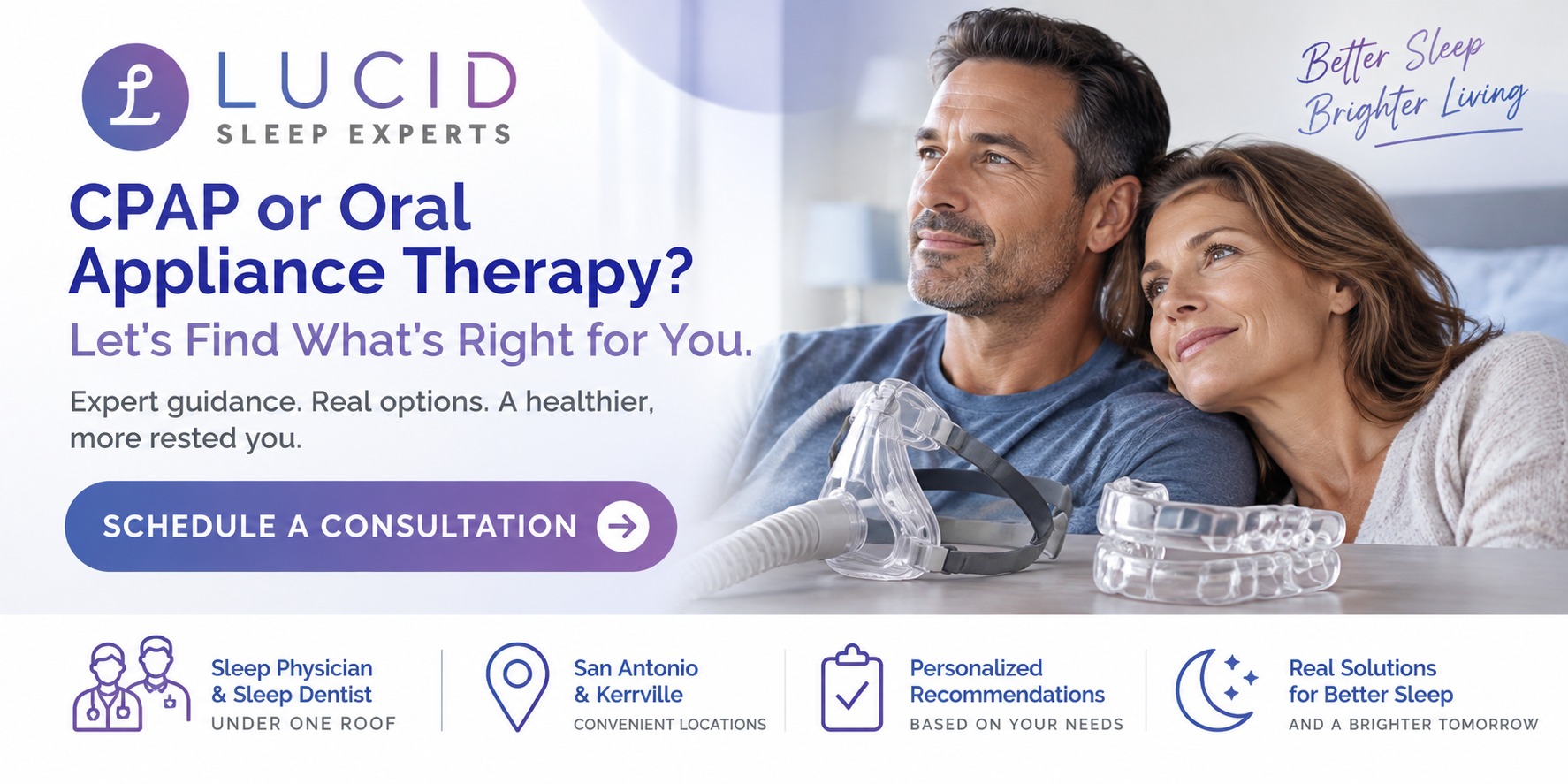
If you already have a sleep apnea diagnosis, or you suspect you have one, schedule a consultation with our sleep team. In a single visit we review your sleep study, examine your airway and your teeth, and tell you plainly which options make sense for you. Both CPAP and oral appliance therapy are available in our San Antonio and Kerrville offices. Click the image below to schedule an appointment today.
First, What Sleep Apnea Is Actually Doing to You
Obstructive sleep apnea (OSA) happens when the soft tissues of your throat relax and collapse during sleep, blocking your airway. Your brain notices the drop in oxygen, jolts you partially awake to reopen the airway, and you fall back asleep without remembering any of it. In moderate to severe cases this cycle repeats dozens of times per hour, all night long.
The consequences are not limited to feeling tired. Untreated OSA is associated with high blood pressure, atrial fibrillation, stroke, type 2 diabetes, depression, motor vehicle accidents, and cognitive decline. It strains your relationship when your partner cannot sleep in the same room. It quietly erodes your energy, your mood, and your ability to focus at work.
Every treatment for OSA has the same goal: keep the airway open while you sleep. CPAP and oral appliance therapy simply accomplish that goal in two very different ways.
What Is CPAP?
CPAP stands for continuous positive airway pressure. A bedside machine draws in room air, pressurizes it, and delivers it through a hose to a mask worn over the nose, the nose and mouth, or just under the nostrils. That steady stream of air acts as a pneumatic splint. It holds the airway open so it cannot collapse.
Modern devices are far quieter and smarter than the machines of twenty years ago. Most are auto-adjusting (APAP), meaning they raise and lower the pressure breath by breath based on what your airway needs. They include heated humidifiers, wireless data reporting, and smartphone apps that show you how many hours you slept with the mask on and how well the therapy worked.
CPAP has been the first-line treatment for OSA for decades, and for good reason. When a patient wears it consistently, it works for nearly everyone at nearly every level of severity.
What Is Oral Appliance Therapy?
Oral appliance therapy (OAT) uses a custom-made dental device, most commonly a mandibular advancement device, that you wear in your mouth during sleep. The appliance gently holds your lower jaw slightly forward. Because the tongue and soft tissues of the throat are attached to the lower jaw, moving the jaw forward pulls those tissues away from the back of the throat and enlarges the airway.
A properly made oral appliance is not the boil-and-bite mouthguard sold online. It is fabricated from digital scans or impressions of your teeth by a dentist trained in dental sleep medicine, and it is adjustable. Over several weeks, the dentist advances the device in small increments (a process called titration) until your breathing during sleep normalizes. A follow-up sleep test confirms the appliance is doing its job.
The American Academy of Sleep Medicine recognizes oral appliance therapy as an appropriate treatment for adults with mild to moderate OSA, and for adults with severe OSA who cannot tolerate CPAP or prefer an alternative. It is not an experimental option. It is a mainstream medical therapy covered by most commercial insurance plans and Medicare when prescribed by a physician.
CPAP: The Pros and Cons
The Pros of CPAP
1. It works across every severity level.Whether your sleep study showed 8 events per hour or 80, CPAP can normalize your breathing. For patients with severe OSA, very low oxygen levels, or significant cardiovascular disease, this reliability matters a great deal. It is the therapy we can most confidently predict will resolve the apnea itself.
2. It is effective immediately.Once your pressure is set, CPAP begins working the first night you wear it. There is no fabrication period and no weeks-long titration. Many patients describe waking up after the first full night of use and feeling a difference they had forgotten was possible.
3. It treats more than obstructive events.Some patients have a mix of obstructive and central sleep apnea, or they have significant oxygen desaturation that needs to be monitored. PAP devices (including BiPAP and adaptive servo-ventilation for more complex cases) can address these patterns in ways an oral appliance cannot.
4. The data is built in.Your CPAP machine records how many hours you wore it, how many breathing events remained, and whether your mask was leaking. Your sleep physician can review this remotely and adjust your settings without you needing another sleep study. That feedback loop makes it easy to fine-tune therapy.
5. It is adjustable at any time.Gained weight? Lost weight? Started a new medication that affects your sleep? Your pressure can be changed in minutes. Nothing needs to be remade.
6. It has no dental or skeletal side effects.CPAP does not move your teeth or change your bite. For patients with significant dental work, loose teeth, or jaw joint problems, that is a meaningful advantage.
The Cons of CPAP
1. Adherence is the central problem.This is the honest truth every sleep physician knows: CPAP only works if you wear it, and a large share of patients do not. Published studies consistently show that somewhere between 30 and 50 percent of patients prescribed CPAP are not using it adequately a year later. A machine sitting in a closet treats nothing.
2. Mask discomfort and skin irritation.Finding a mask that seals without pressing too hard is a real process. Straps can leave marks. Some patients develop irritation on the bridge of the nose or around the mouth. Facial hair, a deviated septum, or a small face can make fitting harder.
3. Dryness, congestion, and bloating.Pressurized air can dry out the nose and mouth, even with a humidifier. Some patients swallow air and wake up bloated. Others experience nasal congestion that makes nasal masks difficult.
4. Claustrophobia and anxiety.For some people, the sensation of a mask on the face and air pushing in is intolerable, no matter how gradually they try to adapt. This is not weakness. It is a real physiological and psychological response that affects a meaningful number of patients.
5. It is not travel-friendly.Even travel-sized units require packing a machine, a hose, a mask, power cords, and distilled water. Camping, international travel, overnight flights, and staying in a hotel room with a partner all become more complicated.
6. Noise and intimacy.Modern machines are quiet, but they are not silent, and mask air leaks can whistle. Many patients tell us the hardest part is what the mask does to intimacy and to how they feel about themselves in bed.
7. Maintenance is ongoing.Masks, cushions, filters, tubing, and humidifier chambers all need regular cleaning and periodic replacement. It is not difficult, but it is one more daily task.
8. Insurance compliance requirements.Most insurers, including Medicare, require you to demonstrate that you are using the device (typically at least four hours per night on 70 percent of nights during a 30-day window in the first 90 days) or they will stop covering it. Patients who struggle to adapt can lose their device before they have had a fair chance to adjust.
Oral Appliance Therapy: The Pros and Cons
The Pros of Oral Appliance Therapy
1. Patients actually wear it.This is the single biggest advantage, and it is the reason oral appliances exist as a medical therapy. Adherence rates for oral appliance therapy are substantially higher than for CPAP in study after study. When we compare a therapy that is highly effective but used half the nights to a therapy that is somewhat less powerful but used every night, the real-world results are often closer than the raw numbers suggest.
2. It is comfortable and discreet.There is no mask, no hose, no machine. Most patients adjust to the appliance within a week or two. Your bed partner may not even notice you are wearing it.
3. It is silent. No motor, no airflow, no leaks. For couples who have struggled with snoring for years, the quiet is often the first benefit they notice.
4. It travels anywhere.The appliance fits in a small case in your pocket or toiletry bag. It needs no electricity, no distilled water, and no luggage space. Camping trips, business travel, and long flights are no longer a problem.
5. It is easy to maintain. Brush it, rinse it, let it dry. That is the routine.
6. It can be combined with CPAP. For some patients with severe OSA who cannot tolerate high CPAP pressures, wearing an oral appliance alongside CPAP allows the pressure to be lowered to a more comfortable level. Combination therapy is a legitimate option for the right patient.
7. It often eliminates snoring even when apnea is mild. Patients with mild OSA or primary snoring frequently find that the appliance resolves both issues in one step.
8. It is well suited to certain patient profiles. Patients with mild to moderate OSA, positional sleep apnea (worse on the back), a lower body mass index, or a retruded lower jaw tend to respond especially well.
The Cons of Oral Appliance Therapy
1. It is less predictable for severe sleep apnea. Oral appliances reduce apnea events significantly in most patients, but they do not resolve them in everyone. Roughly half to two thirds of patients achieve a fully normalized result; others improve substantially but not completely. For patients with severe OSA, especially those with low oxygen levels or heart disease, that uncertainty matters, and CPAP remains the safer first choice.
2. It takes time to get right. From your first dental visit to a fully titrated appliance is typically six to twelve weeks. Scans are taken, the device is fabricated in a lab, it is delivered and adjusted, and then it is advanced gradually until your symptoms resolve. If you need relief tonight, CPAP is faster.
3. It requires a follow-up sleep test. Because an oral appliance does not record its own effectiveness the way a CPAP machine does, a follow-up sleep test (often a home sleep test) is needed to confirm the appliance is controlling your apnea at its final setting. This is not optional. Without it, you are guessing.
4. Dental and jaw side effects are possible. Common early side effects include jaw soreness, tooth tenderness, excess saliva or dry mouth, and a temporary feeling that your bite is "off" in the morning. These usually resolve within weeks. Over years of use, some patients experience small but permanent changes in tooth position or bite. A trained sleep dentist monitors for these and uses morning exercises and adjustments to minimize them.
5. Not everyone is a dental candidate.You need enough healthy teeth to anchor the appliance. Patients with advanced gum disease, extensive missing teeth, loose teeth, or full dentures may not be candidates. Certain jaw joint (TMJ) conditions also require evaluation before proceeding.
6. It requires a sleep dentist, not just a dentist. Making an effective oral appliance for sleep apnea is a specialized skill. It requires training in dental sleep medicine, familiarity with the physician's sleep study, and a titration protocol. A general dentist without this training may deliver an appliance that is comfortable but does not treat the apnea.
7. It does not treat central sleep apnea. If your sleep study shows central events (where the brain fails to signal a breath, rather than the airway collapsing), an oral appliance will not address them.
8. Appliances wear out. A custom appliance generally lasts three to five years before it needs to be replaced. Insurance typically covers replacement at set intervals.
The Question Nobody Asks: Which One Will You Actually Use?
Here is the shift in thinking that changes everything.
Most patients approach this decision by asking, "Which treatment is more effective?" That is the wrong first question, because a treatment's effectiveness in a research study assumes the patient is using it. The right first question is, "Which treatment will I still be using every night a year from now?"
A CPAP machine that normalizes your breathing perfectly on the three nights a week you tolerate it leaves you untreated four nights a week. An oral appliance that reduces your events by 70 percent but that you wear every single night may protect you better over the long run.
That does not mean OAT is always the answer. If you have severe OSA, significant oxygen drops, or heart disease, CPAP's reliability is worth fighting for, and we will fight for it with you through mask fittings, pressure adjustments, and desensitization. If you have mild to moderate OSA and you already know a mask is not going to happen, starting with CPAP just to fail at it delays your treatment by months.
The best treatment is the one that fits your airway, your dental health, your medical risk, and your life. Figuring that out requires someone who can evaluate all four.
Why Most Patients Never Get a Real Choice
Here is a frustrating reality about sleep medicine as it is usually practiced.
A sleep physician diagnoses you and prescribes CPAP, because that is what sleep physicians are trained to do and because they typically do not work with a dentist. If CPAP does not work out, you are told to find a sleep dentist on your own, get a separate referral, start over with a new set of records, and hope the two offices communicate. Many patients simply give up somewhere in that gap.
On the other side, a dentist who markets oral appliances may deliver a device without a physician's diagnosis, without reviewing a sleep study, and without a follow-up test to confirm it worked. The patient feels better, snores less, and assumes the problem is solved. Sometimes it is. Sometimes the apnea is still there.
Neither of these is patient-centered care. Both are the result of a fragmented system.
How Lucid Sleep Experts Does It Differently
At Lucid Sleep Experts, a sleep physician and a sleep dentist practice together. We built the practice this way deliberately, because we believe every patient deserves a real choice made with complete information.
When you come to us, you are evaluated by a physician who can interpret your sleep study, assess your cardiovascular and metabolic risk, and determine how urgently and how aggressively your apnea needs to be treated. In the same practice, a dentist trained in dental sleep medicine examines your teeth, gums, jaw, and airway to determine whether you are an oral appliance candidate and how likely you are to respond.
Then we talk. Not one provider advocating for one therapy, but a team laying out your actual options with the pros and cons applied to your situation.
If CPAP is right for you, we coordinate the set up from our office with a DME provider that is contracted with your insurance and subsequently monitor your data. If oral appliance therapy is right for you, we fabricate and titrate your appliance and then confirm it is working with a follow-up sleep test. If you start on one and need to switch, or if combination therapy makes sense, nothing falls through the cracks because it is all happening in one place.
Our patients in San Antonio and Kerrville do not have to choose between a physician who only offers CPAP and a dentist who only offers appliances. They get both perspectives, in one plan.
Your Plan: Three Steps to the Right Treatment
Step 1: Get a clear diagnosis.If you have not had a sleep study, we will arrange one, often as a home sleep test you complete in your own bed. If you have already been diagnosed elsewhere, bring your results. We will review them with you and explain what the numbers mean for your health.
Step 2: Get evaluated for both therapies.Our physician and dentist assess you for CPAP and for oral appliance therapy in a coordinated visit. You leave knowing which options are medically appropriate, which one we recommend, and why.
Step 3: Start therapy and let us manage the follow-up.Whether you choose CPAP, an oral appliance, or both, we handle the setup, the adjustments, the follow-up testing, and the insurance paperwork. Your job is to sleep. Ours is everything else.
What Happens If You Do Nothing
We would be doing you a disservice if we did not say this plainly.
Untreated sleep apnea does not stay the same. It tends to worsen with age and weight gain. The cardiovascular strain accumulates. The daytime fatigue erodes your work, your driving safety, and your patience with the people you love. Many of our patients tell us they wish they had acted five years earlier, not because the treatment was hard, but because they did not realize how much of themselves they had lost to poor sleep until they got it back.
Choosing between CPAP and oral appliance therapy is a decision worth taking seriously. Choosing neither is a decision too, and it is the one with the highest cost.
What Life Looks Like on the Other Side
Picture waking up before your alarm and not needing a second cup of coffee to feel human. Picture your partner sleeping in the same bed again, without earplugs. Picture a drive to Kerrville or across San Antonio without fighting to keep your eyes open. Picture a blood pressure reading that makes your primary care doctor smile.
This is not a fantasy. It is the routine outcome of treating sleep apnea with a therapy you will actually use. Whether that therapy is a mask or a mouthpiece matters far less than the fact that you are wearing it tonight, and tomorrow night, and the night after that.
The Bottom Line on CPAP vs Oral Appliance Therapy
CPAP is the most powerful tool we have for sleep apnea, and for severe or medically complex patients it remains the first choice. Its weakness is not effectiveness. It is that many patients cannot or will not wear it.
Oral appliance therapy is comfortable, quiet, portable, and far easier to live with, which is why patients wear it. Its weakness is that it is less predictable for severe disease and requires a trained sleep dentist and a follow-up sleep test to do correctly.
Neither is right for everyone. Both are right for someone. The only way to know which is right for you is a proper evaluation by a team that offers both and has no reason to push you toward one.
That is what we built Lucid Sleep Experts to be.
Schedule your consultation at Lucidtx.com, or call our San Antonio or Kerrville office to get started. Bring your questions and your sleep study if you have one. We will take it from there.
Leave the Rest to Us.
Shana Hansen, MD, is the Medical Director of Lucid Sleep Experts, a sleep medicine and dental sleep medicine practice serving San Antonio and Kerrville, Texas. Dr. Hansen works alongside the practice's dental sleep medicine team to provide integrated evaluation and treatment for obstructive sleep apnea, including CPAP therapy and custom oral appliance therapy.
This article is for educational purposes and does not replace an individual medical evaluation. Treatment decisions for sleep apnea should be made with a qualified sleep physician.