.avif)
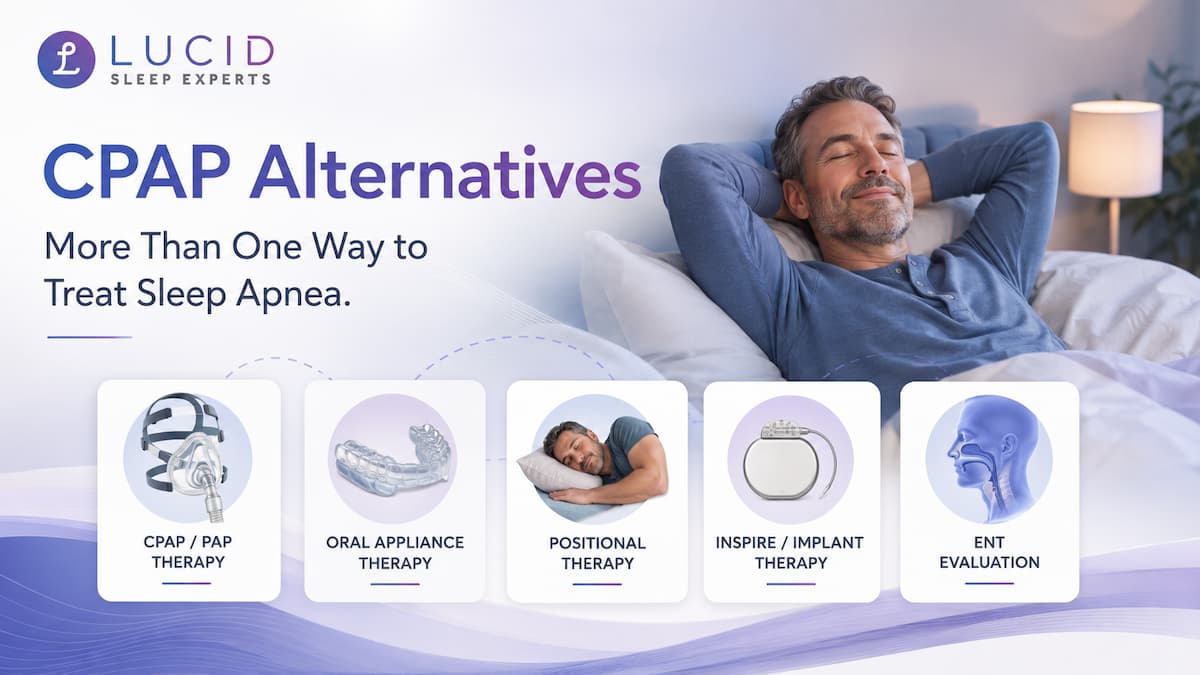
CPAP Alternatives: More Than One Way to Treat Sleep Apnea
By Shana Hansen, MD, Sleep Medicine Physician at Lucid Sleep
You did everything right.
You noticed the exhaustion, the snoring, the mornings where you woke up feeling like you never slept at all. You talked to your doctor. You completed a sleep study. You got your diagnosis: obstructive sleep apnea. And then you got the prescription almost everyone gets, a CPAP machine.
Maybe you tried it for a few weeks. Maybe you pushed through for months. You swapped masks, adjusted straps, and told yourself you would get used to it. But every night felt like a battle. The mask leaked. Your mouth was dry. Your nose was congested. You woke up bloated and uncomfortable, pulled the mask off at 2 a.m., and eventually the machine ended up in the closet.
Now you are stuck in the worst possible place. You know you have sleep apnea. You know it is hurting your health. And you believe the one treatment you were given is the only treatment that exists.
As a sleep medicine physician, I want to tell you what I tell my own patients: a lot of people get put on APAP or CPAP when they have sleep apnea, but it is not going to work for everybody, and not everybody can tolerate it.
If CPAP has failed you, you have not failed. You simply have not found your treatment yet. There is more than one way to treat sleep apnea, and in this guide I will walk you through every option, including the ones you may never have been told about.
You Deserve a Sleep Team That Refuses to Give Up on You
At Lucid Sleep Experts, my colleagues and I have helped thousands of patients across San Antonio and Kerrville, Texas find sleep apnea treatment that actually fits their lives. Our team is unusual in the best way. We bring sleep medicine, dental sleep medicine, and a full clinical support staff under one roof, which means we are not limited to a single therapy. We offer CPAP management, oral appliance therapy, positional therapy, combination therapy, Inspire evaluation, and ENT referral, and we can pivot between them as your needs change.
We also understand the practical side. We work extensively with TRICARE and Medicare patients, and we help you understand your coverage before you commit to anything.
Ready to find the treatment that finally works for you? Schedule your consultation with Lucid Sleep Experts today or call our San Antonio or Kerrville office. Your first step is a conversation, not a commitment.
Now, let's walk through your options, starting with the one you may have already tried.
Step One: Don't Abandon CPAP Before You Troubleshoot It
This might sound surprising in an article about CPAP alternatives, but it is exactly how I approach every struggling patient, and it matters for your long-term success.
When patients come back to me and they have already gone through several masks, I still try to help them. I look at whether there is something I can adjust pressure-wise on their machine, and I ask about the other things that might be causing problems, whether it is dry mouth, nasal congestion, or bloating.
The truth is that many patients who "fail" CPAP were never actually set up for success. Before moving on, here is what I investigate:
Pressure settings. If your pressure is too high, you may fight the machine all night, swallow air, and wake up bloated (a condition called aerophagia). If it is too low, your apnea is not fully treated and you still feel exhausted. Small pressure adjustments, or switching between CPAP, APAP, and BiPAP modes, can transform the experience.
Dry mouth. Often caused by mouth leak or insufficient humidification. Solutions include heated humidifiers, chin straps, or switching mask styles.
Nasal congestion. If you cannot breathe through your nose, a nasal mask becomes miserable fast. Treating the underlying congestion, sometimes with an ENT evaluation, or switching to a full-face mask can solve the problem.
Bloating and air swallowing. Frequently a pressure issue, and one of the most fixable complaints when your physician actually looks at your data.
Mask fit. There are dozens of mask styles. If you have only tried one or two, you have barely scratched the surface.
Sometimes these adjustments are all it takes, and the patient who hated their machine becomes a patient who sleeps well with it. But sometimes they are not enough, and this is where many practices stop. Mine does not.
If we have exhausted all of those options, then we have to talk about other treatment. Because if you are not going to use your PAP machine, my job is to find an alternative that is still going to improve your sleep. A perfect therapy you will not use is worthless. A very good therapy you will use every night can change your life.
CPAP Alternative #1: Oral Appliance Therapy
If there is one treatment that deserves far more attention than it gets, it is oral appliance therapy (OAT).
An oral appliance is a custom-fitted device, made by a qualified sleep dentist, that you wear while you sleep. It looks similar to a retainer or athletic mouthguard, but it is precision-engineered to do one critical job: it gently repositions your lower jaw slightly forward, which keeps your airway open and prevents the collapse that causes apnea events.
Who is it for? In my experience, an oral appliance definitely works great for mild to moderate sleep apnea, and it can work for severe cases as well, particularly in combination with other therapies. It is also the leading option for patients who cannot tolerate CPAP regardless of severity, because a treatment you use every night beats a stronger treatment you never use.
Why my patients love it:
- No mask, no hose, no machine noise
- Nothing to plug in, which makes travel effortless
- No dry mouth from forced air, no strap marks, no claustrophobia
- Easy to clean and maintain
- Your bed partner will barely notice it
What the process looks like at Lucid Sleep Experts: I confirm your diagnosis and candidacy, then our dental sleep medicine team takes precise digital scans of your teeth and bite. Your custom appliance is fabricated, fitted, and then titrated over follow-up visits, meaning we fine-tune the jaw position until your airway stays open and your symptoms resolve. We then verify effectiveness objectively, often with a follow-up home sleep test, because "feeling better" is good but proof is better.
A note on insurance: Custom oral appliances for diagnosed obstructive sleep apnea are covered as durable medical equipment by Medicare and many commercial plans when medical criteria are met, and TRICARE has coverage pathways as well. This surprises many of my patients who assume OAT is an out-of-pocket luxury. Our team handles the documentation and helps you understand your benefits up front.
CPAP Alternative #2: Positional Therapy
For a significant number of my patients, sleep apnea is dramatically worse, or only present, when they sleep on their back. Gravity pulls the tongue and soft tissues backward, narrowing the airway. This is called positional obstructive sleep apnea, and it opens the door to a refreshingly simple intervention: keeping you off your back, or a little bit elevated.
Modern positional therapy has come a long way from the old tennis-ball-sewn-into-a-t-shirt trick. Today's options include:
- Wearable positional devices that vibrate gently when you roll onto your back, training you to stay on your side without waking you
- Specialized positional pillows and wedges that make side sleeping comfortable and sustainable
- Elevating the head of the bed, which reduces airway collapse for many patients
Positional therapy is rarely a standalone solution for moderate to severe apnea, but as a component of a combination plan, it can be the difference between partial and complete treatment. Your sleep study data tells me whether your apnea has a positional component, which is one more reason proper diagnostic testing matters.
CPAP Alternative #3: Combination Therapy
Here is something most patients have never been told: sleep apnea treatments are not mutually exclusive. We can stack them.
We can always combine an oral appliance with something else, such as positional therapy. And here is the one that surprises people most: you can use both a dental appliance and a PAP machine together.
Combination therapy is one of the most powerful and underused strategies in sleep medicine. A few real-world examples from my practice:
Oral appliance + positional therapy. A patient with moderate apnea gets most of the way there with an oral appliance, and adding side-sleeping training eliminates the remaining events.
Oral appliance + PAP. For patients with severe apnea who struggle with high CPAP pressures, wearing an oral appliance alongside the machine keeps the airway more open mechanically, which often allows me to reduce the pressure significantly. Lower pressure means less bloating, fewer leaks, less discomfort, and dramatically better tolerance. Some patients who abandoned CPAP at high pressures do beautifully once an appliance lets them run at a gentler setting.
Weight management + any therapy. Weight loss does not cure sleep apnea for everyone, but for many patients it reduces severity, which can move someone from "CPAP required" territory into "oral appliance is sufficient" territory over time.
The point is this: your treatment plan should be built like a custom solution, not pulled off a shelf. That only happens when your sleep team has every tool available and the expertise to combine them.
CPAP Alternative #4: Inspire Therapy (Hypoglossal Nerve Stimulation)
For patients with moderate to severe obstructive sleep apnea who cannot tolerate CPAP, Inspire therapy represents one of the most significant advances in sleep medicine in decades.
Inspire is a small implanted device, placed during a short outpatient procedure, that monitors your breathing while you sleep. When it detects an inhalation, it delivers a gentle pulse to the hypoglossal nerve, which moves your tongue slightly forward and keeps your airway open. You turn it on with a small remote before bed and turn it off when you wake up. No mask. No hose. No appliance in your mouth.
Who qualifies? Inspire has specific candidacy criteria, including apnea severity range, body mass index limits, and an airway evaluation to confirm your anatomy will respond. Not everyone qualifies, which is exactly why an honest evaluation matters. At Lucid Sleep Experts, we assess Inspire candidacy as part of our full treatment discussion and coordinate the referral pathway for patients who are good candidates.
CPAP Alternative #5: ENT Evaluation and Surgical Options
Sometimes the obstacle is anatomical. A severely deviated septum, enlarged tonsils, nasal polyps, or chronic sinus disease can both worsen sleep apnea and sabotage every other treatment. A patient who cannot breathe through their nose will struggle with a nasal CPAP mask and may struggle with an oral appliance too.
This is where an ENT (ear, nose, and throat) evaluation becomes essential. Depending on findings, options may include septoplasty, turbinate reduction, tonsillectomy, or other airway procedures. In some cases, surgery is not the primary sleep apnea treatment but the enabler that finally makes CPAP or oral appliance therapy comfortable and effective.
Lucid Sleep Experts maintains ENT referral relationships precisely for these situations, and we coordinate care so nothing falls through the cracks between specialists.
Why Untreated Sleep Apnea Is Not an Option
I need to be honest with you about the stakes, because the closet where your CPAP machine sits is not a neutral place.
Untreated obstructive sleep apnea is associated with significantly elevated risks of high blood pressure, heart attack, stroke, atrial fibrillation, type 2 diabetes, and daytime motor vehicle accidents. It erodes memory, mood, focus, and energy. It strains relationships, and not just because of the snoring. Every night without treatment, your body cycles through oxygen drops and stress-hormone surges that it was never designed to endure.
Here is the picture on the other side: patients who find the right therapy routinely tell me it changed their lives. They wake up rested for the first time in years. Their blood pressure improves. Their partner sleeps in the same bed again. Their afternoon crashes disappear. That outcome is available to you, and CPAP is only one of several roads that lead there.
Your Plan: Three Simple Steps
Getting from exhausted to rested does not have to be complicated. Here is how it works at Lucid Sleep Experts:
1. Schedule a consultation. Meet with our sleep medicine team in San Antonio or Kerrville, in person or via telehealth. Bring your history, your frustrations, and your questions. If you have prior sleep study results, we will review them. If you need testing, we offer convenient home sleep testing so you can be evaluated in your own bed.
2. Get a complete evaluation. I look at your sleep study data, your airway, your anatomy, your CPAP history if you have one, and your lifestyle. I check whether your apnea is positional, whether your PAP settings were ever optimized, and which alternatives you are a candidate for.
3. Start a treatment you will actually use. Whether that is a retuned PAP setup, a custom oral appliance, positional therapy, a combination plan, Inspire evaluation, or an ENT referral, we build it around you, then follow up and verify it is working.
Frequently Asked Questions About CPAP Alternatives
Is an oral appliance as effective as CPAP? For mild to moderate sleep apnea, custom oral appliances deliver excellent results, and because patients tend to use them more consistently than CPAP, real-world effectiveness is often comparable. For severe apnea, CPAP remains the gold standard, but appliances can still play a role alone or in combination when CPAP is not tolerated.
Will insurance cover a CPAP alternative? In many cases, yes. Medicare covers custom oral appliances for diagnosed OSA when criteria are met, and TRICARE and commercial plans have coverage pathways as well. Our team verifies your benefits before treatment begins.
I failed CPAP years ago. Do I need a new sleep study? Possibly. If significant time has passed or your weight or health has changed, updated testing gives us an accurate baseline. Home sleep testing makes this far easier than it used to be.
Can I try more than one option?Absolutely. Treatment is not a one-time decision. Many of my patients start with one therapy and adjust or combine over time as we track results together.
There Is More Than One Way to Treat Sleep Apnea. Let's Find Yours.
If CPAP did not work for you, that is information, not a verdict. There are definitely options if you come in having trouble with PAP.
You do not have to choose between a mask you hate and a disease you ignore. You need a sleep team with every option on the table and the expertise to match one to you.
Schedule your consultation with Lucid Sleep Experts at our San Antonio or Kerrville location, or call us today. Better sleep is closer than you think.
Shana Hansen, MD is a Sleep Medicine Physician at Lucid Sleep, which provides comprehensive sleep apnea care, including home sleep testing, CPAP management, oral appliance therapy, Inspire therapy evaluation, and ENT referrals, serving San Antonio, Kerrville, and surrounding Texas communities. We proudly serve TRICARE and Medicare patients.