.avif)
Positional Therapy for Sleep Apnea: The Back-Sleeping Fix Most Patients Have Never Heard Of

Kevin Asp, CRT, RPSGT, FAAST, Chief Operating Officer, Lucid Sleep Experts
You Sleep Fine on Your Side. So Why Does Your Sleep Apnea Feel Unbeatable?
Your spouse has told you the same story a hundred times. When you roll onto your back, the snoring starts. Then the silence. Then the gasp that makes them sit up and check on you. When you're on your side, things quiet down.
You've probably wondered if that pattern means something. Here's the answer most people never get: it means a great deal, and for the right patient, it can change the entire treatment conversation.
Roughly half of all people with obstructive sleep apnea have what sleep specialists call positional obstructive sleep apnea (POSA). In these patients, apnea events occur at least twice as often when sleeping on the back (the supine position) as when sleeping on the side. For a meaningful subset, apnea nearly disappears in the side-sleeping position altogether.
If that describes you, positional therapy for sleep apnea may be one of the most practical, comfortable, and affordable treatment options available. And yet most patients have never had a provider explain it to them.
At Lucid Sleep Experts, we've built our practice around a simple belief: you deserve a treatment plan matched to your specific sleep apnea, not a one-size-fits-all prescription. This article walks you through what positional sleep apnea is, how positional therapy works, what the research actually shows, and how to find out whether you're a candidate.
What Is Positional Sleep Apnea?
Obstructive sleep apnea happens when the soft tissues of your throat, including the tongue base, soft palate, and side walls of the airway, collapse during sleep and block airflow. Your brain senses the drop in oxygen, jolts you partially awake to restore breathing, and the cycle repeats. In moderate to severe cases, this can happen dozens of times per hour.
Body position changes the physics of that collapse.
When you lie on your back, gravity pulls the tongue and soft palate backward toward the rear wall of the throat. The airway narrows front to back, and the tissue has a shorter distance to travel before it seals shut. When you lie on your side, gravity pulls those same tissues sideways instead of backward, and the airway tends to stay more open.
Sleep physicians quantify this with a measurement called the apnea-hypopnea index, or AHI, which counts the number of apnea and hypopnea events per hour of sleep. The classic definition of positional obstructive sleep apnea, first described by Dr. Rosalind Cartwright in the 1980s, is straightforward: your supine AHI is at least twice your non-supine AHI.
Some patients meet an even more specific definition sometimes called exclusive positional OSA. Their overall AHI is elevated, but their side-sleeping AHI falls below 5 events per hour, which is within the normal range. In practical terms, these patients have clinically significant sleep apnea on their back and near-normal breathing on their side.
How Common Is Positional OSA?
More common than most people expect. Published studies estimate that between 50 and 60 percent of patients with obstructive sleep apnea have a positional component, and the percentage is even higher among patients with mild to moderate disease. Positional OSA is also more common in younger patients, patients with lower body mass index, and patients whose apnea severity falls in the mild to moderate range.
That last point matters. The patients most likely to abandon CPAP, often those with milder disease who don't feel sick enough to tolerate a mask every night, are frequently the same patients most likely to respond to positional therapy.
Great Treatment Exists, but Nobody Told You About It
Here's where the frustration sets in for a lot of the patients we meet.
You were diagnosed with sleep apnea. You were handed a CPAP machine. Maybe it worked beautifully, and if so, that's a genuine win worth protecting. But maybe it didn't. Maybe you fought the mask for months, felt claustrophobic, ripped it off in your sleep, and eventually shoved the whole setup into a closet. Maybe you were told, or you assumed, that quitting CPAP meant giving up on treatment entirely.
Nobody looked at your sleep study and said, "Interesting. Your apnea is almost entirely supine-dependent. Let's talk about what that means."
That conversation is the one we want to have with you. Because untreated sleep apnea is not a snoring problem. It's a cardiovascular problem, a metabolic problem, a daytime-safety problem, and a quality-of-life problem. Untreated OSA is associated with elevated risks of high blood pressure, atrial fibrillation, stroke, type 2 diabetes, motor vehicle accidents, and depression. The stakes of doing nothing are real, and they compound quietly, night after night.
The good news is that "CPAP or nothing" has never been the true state of sleep medicine. It's just the version many patients receive.
From Tennis Balls to Smart Sensors: How Positional Therapy Has Evolved
Positional therapy is one of the oldest ideas in sleep medicine, and for decades it had a serious credibility problem, because the earliest version of it was, quite literally, a tennis ball.
The Old Way: The Tennis Ball Technique
For years, patients with positional apnea were told to sew a tennis ball into the back of a T-shirt or stuff one into a sock pinned between the shoulder blades. Roll onto your back, get poked, roll back to your side. Crude, cheap, and in the short term, it worked for some people.
The problem was staying power. Long-term studies of the tennis ball technique showed dismal adherence. In one frequently cited follow-up study, only about 10 percent of patients were still using it after roughly two and a half years. Patients found it uncomfortable, it disrupted sleep quality, and many simply learned to sleep on top of the ball or abandoned it. Foam wedges, backpack-style devices, and bulky positioners suffered similar fates for similar reasons: they treated the position by punishing the sleeper.
The New Way: Vibrotactile Positional Therapy Devices
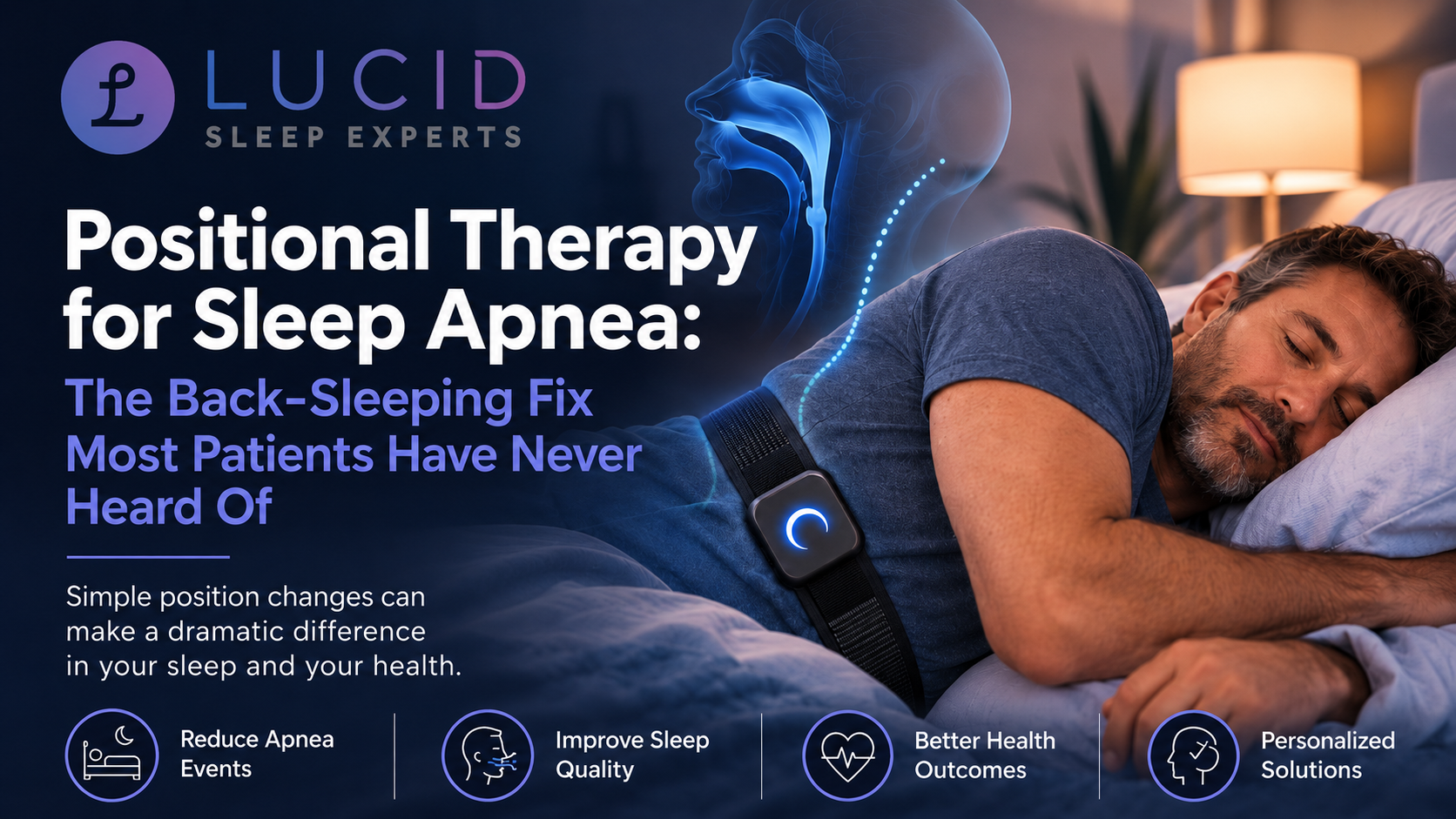
Modern positional therapy takes a completely different approach. Today's devices are small electronic sensors, typically worn on the chest or around the neck, that detect body position in real time. When the device senses that you've rolled onto your back, it delivers a gentle, gradually intensifying vibration. Not enough to wake you. Just enough to prompt your body to shift back to your side.
Think of it as sleep position training rather than sleep position punishment. Over weeks of use, many patients develop a durable habit of side sleeping, and the device's job gets easier over time.
The difference in patient experience is night and day. Clinical trials of vibrotactile devices have reported adherence rates in the range of 70 to 90 percent at follow-up, a dramatic improvement over the tennis ball era. Many devices also record nightly data, including time spent supine, number of position changes, and response to vibrations, which allows your sleep team to verify that the therapy is actually working rather than taking it on faith.
What the Research Shows
The evidence base for positional therapy in properly selected patients has grown substantially over the past decade. A few highlights worth knowing:
Randomized controlled trials of vibrotactile positional devices in patients with positional OSA have shown significant reductions in supine sleep time and meaningful reductions in overall AHI, in many cases bringing mild to moderate positional OSA into the normal or near-normal range.
Comparative studies have examined positional therapy head to head against other treatments in positional OSA patients. While CPAP generally produces a larger absolute drop in AHI, several trials found that real-world effectiveness was comparable because patients used positional therapy more consistently than they used CPAP. A treatment that works 100 percent when used but sits in the closet is outperformed by a treatment that works well and gets used every night.
Positional therapy also pairs well with other treatments, which brings us to one of the most important points in this article.
Positional Therapy Plus Oral Appliance Therapy: A Powerful Combination
At Lucid Sleep Experts, we offer both medical sleep services and dental sleep medicine under one coordinated umbrella, and this is where that integration pays off for patients.
Oral appliance therapy uses a custom-fitted device, worn like a retainer, that holds the lower jaw slightly forward during sleep. This tightens the tissues of the airway and reduces collapse. For many patients with mild to moderate OSA, and for CPAP-intolerant patients with more severe disease, oral appliances are a well-established, guideline-supported treatment.
Here's the clinically interesting part: oral appliances and positional therapy attack airway collapse from two different directions. The appliance addresses the front-to-back dimension by advancing the jaw. Positional therapy addresses the gravitational component by keeping you off your back. Research on combination therapy has shown that patients who don't fully respond to an oral appliance alone often reach treatment success when positional therapy is added, and vice versa.
For a patient whose AHI drops from 28 to 12 on an oral appliance, adding positional therapy may be the difference between partial improvement and a fully treated result. That's the kind of individualized, layered treatment planning that a combined medical and dental sleep practice is built to deliver.
Who Is a Good Candidate for Positional Therapy?
Positional therapy is a targeted tool, not a universal one. You're most likely to benefit if:
Your sleep study shows a clear positional pattern. Your supine AHI is at least double your non-supine AHI, and ideally your side-sleeping AHI is low. This is the single most important criterion, and it can only be established with objective testing.
Your OSA is mild to moderate overall. Patients with severe OSA that persists in all body positions generally need CPAP, oral appliance therapy, or another primary treatment, though positional therapy may still play a supporting role.
You can physically sleep on your side. Patients with shoulder injuries, certain chronic pain conditions, or other constraints that make side sleeping intolerable may need alternative approaches.
You struggled with CPAP or want a less intrusive option. Positional therapy is quiet, small, travel-friendly, and requires no mask, hose, electricity at the bedside, or distilled water.
You're already on treatment but not fully controlled. As described above, positional therapy can be layered with oral appliance therapy, and in some cases with CPAP, where reducing supine sleep can lower the pressure a patient needs.
Who is generally not a candidate? Patients whose apnea is just as severe on their side as on their back, patients with predominantly central sleep apnea, and patients with severe untreated disease who need the reliability of a primary therapy first. An honest assessment matters more than enthusiasm for any single device.
How Positional Sleep Apnea Is Diagnosed
You can't diagnose positional sleep apnea from symptoms alone, and you shouldn't buy a positional device off the internet based on a spouse's observation, however accurate it may turn out to be. Confirming a positional component requires sleep testing that records body position alongside breathing, so your care team can compare your supine AHI against your non-supine AHI directly.
Not every sleep test captures position data. In-lab polysomnography records body position as a standard channel, and some (but not all) home sleep apnea testing devices include a position sensor. This is worth asking about, because a study without position data can tell you that you have sleep apnea and how severe it is, but it can't tell you how much of that severity depends on sleeping on your back.
Night-to-night variability matters here too. Sleep apnea severity and body position both fluctuate from one night to the next. A patient who happens to spend a single test night mostly on their side can look deceptively healthy, while a patient who spends one bad night entirely supine can look more severe than they truly are. This is one of the reasons multi-night testing has become an increasingly important standard in sleep medicine, and it's why our practice tests across five nights rather than one.
At Lucid Sleep Experts, we start with a clinical evaluation and multi-night home sleep testing to establish an accurate diagnosis and severity picture. When your history strongly suggests a positional component, such as a bed partner reporting that your snoring and pauses happen mainly on your back, we factor that into your treatment planning and, where confirmation with position data would change the recommendation, we guide you to the right type of study to get it. The goal is always the same: a treatment plan built on evidence, not assumption.
Three Simple Steps
We know the sleep medicine world can feel confusing, fragmented, and slow. We've designed our process so it isn't.
Step 1: Schedule a consultation. Meet with our sleep team in San Antonio or Kerrville, or via telemedicine. We'll review your symptoms, your history, and any prior sleep studies you've had.
Step 2: Complete a multi-night home sleep test. You'll sleep in your own bed while a small device records your breathing and oxygen levels across several nights, giving us a far more reliable picture of your sleep apnea than a single night can.
Step 3: Get a treatment plan built for your sleep apnea. If your evaluation points to positional OSA, we'll walk you through positional therapy options, whether as standalone treatment or in combination with oral appliance therapy or other approaches, and follow your progress over time. Many modern positional devices record their own nightly position data, which becomes a built-in way to verify the therapy is working once you start.
No guesswork. No pressure toward a single product. Just a clear path from "my spouse says I stop breathing on my back" to a verified diagnosis and a treatment you'll actually use.
What Success Looks Like
Imagine waking up without the headache. Getting through the 2 p.m. meeting without fighting your eyelids. Your spouse sleeping in the same room again, without one ear open. Your blood pressure trending in the right direction at your next physical, and your energy showing up for the people and work that matter to you.
For the right patient, positional therapy makes that picture achievable with nothing more than a small sensor and a trained habit of side sleeping. That's not a miracle. It's just good sleep medicine, matched carefully to the right diagnosis.
And if your testing shows you're not a positional patient? You'll still walk away with something valuable: an accurate diagnosis and a treatment plan built on evidence rather than assumption. Either way, you win.
Frequently Asked Questions About Positional Therapy for Sleep Apnea
Does positional therapy really work as well as CPAP? For carefully selected patients with positional OSA, studies have shown that positional therapy can achieve comparable real-world effectiveness to CPAP, largely because patients use it more consistently. CPAP remains the gold standard for severe and non-positional OSA. Candidacy is everything, which is why objective testing comes first.
Can I just train myself to sleep on my side without a device? Some patients can, but most people change position 10 to 30 times per night without any awareness of it. Willpower doesn't operate while you're asleep. Modern devices provide the automatic feedback your sleeping brain needs, along with data confirming the therapy is working.
Is positional therapy covered by insurance? Coverage varies by plan and by device. Our team reviews your benefits, explains your options clearly, and helps you understand costs before you commit to anything.
What about wedge pillows and body pillows? Positioning pillows can help some patients as a supportive measure, but they don't provide feedback when you roll off of them, and they lack the objective usage data that vibrotactile devices offer. We generally view them as a supplement rather than a primary therapy.
Do all sleep tests detect positional sleep apnea? No. In-lab sleep studies record body position as standard, but home sleep test devices vary, and some don't include a position sensor. If a positional pattern is suspected, it's worth asking your provider whether your study captured position data, and whether confirmation would change your treatment options.
I failed CPAP years ago. Is it worth getting retested? Absolutely. Testing technology, treatment options, and our understanding of positional OSA have all advanced significantly. Many patients who "failed" sleep apnea treatment a decade ago simply never had their positional component identified.
How quickly does positional therapy work? The position correction begins the first night you wear the device. Most vibrotactile devices use a brief acclimation period over the first week or two, gradually increasing feedback so your sleep isn't disrupted while the habit forms.
Don't Spend Another Year Sleeping on the Problem
Every night of untreated sleep apnea puts strain on your heart, your metabolism, and your mind. If your apnea gets dramatically worse on your back, that's not trivia. It's actionable clinical information, and it might be the key to a treatment you can finally live with.
Take the first step today. Schedule your consultation with Lucid Sleep Experts in San Antonio or Kerrville at lucidtx.com, and let's find out, with real data, whether positional therapy belongs in your treatment plan.
Schedule Your Sleep Consultation
Kevin Asp, CRT, RPSGT, FAAST, is the Chief Operating Officer of Lucid Sleep Experts and a Fellow of the American Association of Sleep Technologists. He has worked in sleep medicine for more than three decades, including operating sleep disorder centers and authoring a chapter on consumer sleep-tracking technologies in the 4th edition of Fundamentals of Sleep Technology. Lucid Sleep Experts provides integrated medical and dental sleep medicine care in San Antonio and Kerrville, Texas.