.avif)
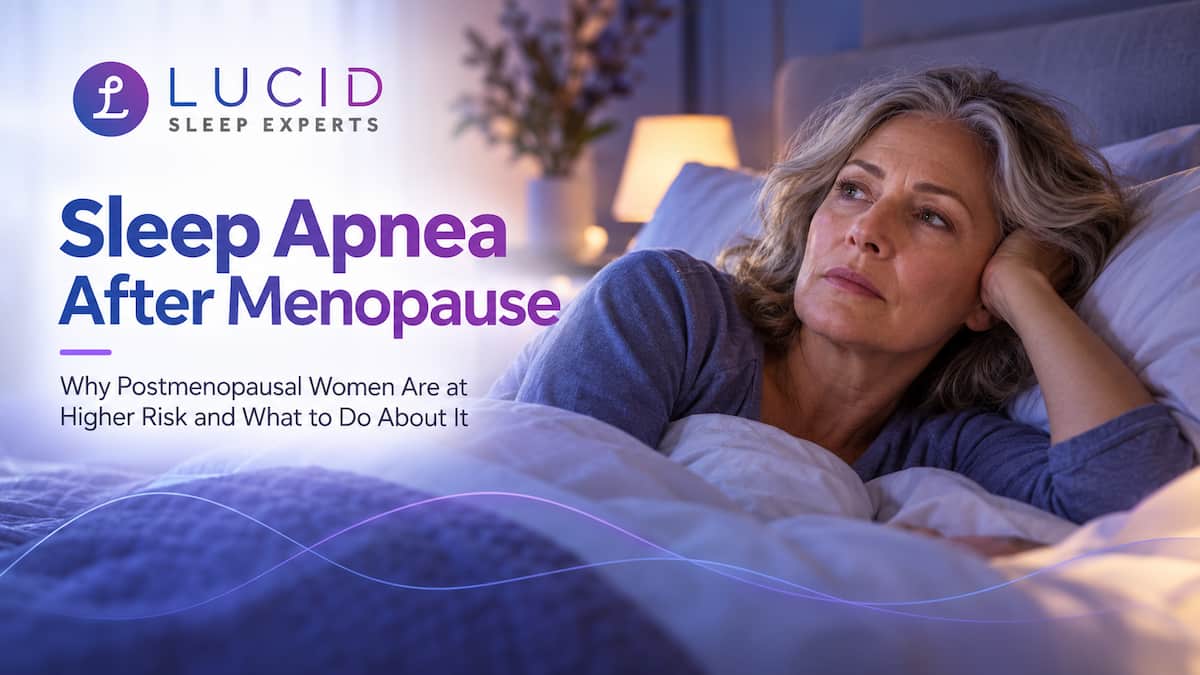
Sleep Apnea After Menopause: Why Postmenopausal Women Are at Higher Risk and What to Do About It
By Shana Hansen, MD
You are not imagining it, and it is not just your age
You used to sleep through the night. Now you wake at 2 a.m. with your heart pounding, your nightgown damp, and your mind racing about nothing in particular. You fall back asleep eventually, but the morning feels like you never slept at all. Your doctor says it is menopause. Your friends say it is stress. Your husband says you have started snoring, which you find hard to believe.
Here is what nobody has told you: for a woman who has gone through menopause, that pattern is one of the most common ways obstructive sleep apnea shows up. Not loud snoring and gasping, the version you have seen on television. A quieter, more exhausting version that hides behind hot flashes, insomnia, and the assumption that feeling worn down is simply what happens after 50.
Sleep apnea after menopause is not rare. It is not something you have to accept. And it is treatable, often without a CPAP machine. If you have spent months or years being told your exhaustion is a normal part of aging, this article is for you.
What menopause does to your airway while you sleep
Before menopause, women are protected from sleep apnea in a way men are not. Research consistently shows that premenopausal women develop obstructive sleep apnea at a fraction of the rate of men the same age. After menopause, that protection disappears. Studies of postmenopausal women have found rates of sleep apnea two to three times higher than in premenopausal women, and in women past 60, the numbers approach those of men.
The reason comes down to hormones, and specifically to two of them.
Progesterone is a respiratory stimulant. It increases your drive to breathe and helps keep the muscles of the upper airway firm during sleep. When progesterone falls, the throat relaxes more readily, and the brain is slower to respond when airflow drops.
Estrogen supports muscle tone in the airway and influences where the body stores fat. As estrogen declines, fat shifts away from the hips and toward the abdomen and neck. A thicker neck and a heavier chest wall both make the airway more likely to collapse during sleep. Many women gain weight during this period without changing anything about how they eat, and the pattern of that weight gain matters more than the amount.
There are other contributors, too. Sleep itself becomes lighter and more fragmented after menopause, which makes the airway more vulnerable. Hot flashes wake you, and each awakening resets the cycle. Over time, the nightly interruptions become so familiar that they stop registering as abnormal.
The problem underneath the problem
The physical problem is an airway that closes repeatedly while you sleep. But that is rarely the problem that drives a woman to look for answers.
The real problem is how it makes you feel. You are tired in a way that coffee does not touch. You snap at people you love. You walk into a room and forget why. You have stopped trusting your own memory, your own mood, and your own body. You wonder whether this is just who you are now.
And underneath that is a quieter frustration: you have asked for help and been handed a shrug. Menopause has become a catchall explanation for everything a woman over 50 experiences, and that has left a generation of women undiagnosed. That is not acceptable. You deserve a real answer, and you deserve someone who will look for it.
Why sleep apnea in women looks nothing like the textbook
Most of what the public knows about sleep apnea was learned from middle-aged men. The classic picture is a heavyset man who snores loudly, stops breathing, gasps, and falls asleep in front of the television. Screening questionnaires were built around that picture. So were many doctors' instincts.
Women with sleep apnea often present differently, and postmenopausal women especially so. The symptoms that bring them to a doctor are easy to attribute to something else:
- Insomnia. Trouble falling asleep or staying asleep is one of the most common complaints in women with sleep apnea, and it is almost never recognized as a sign of a breathing problem. Many women are treated for the insomnia alone without ever being tested for apnea.
- Fatigue rather than sleepiness. Men with sleep apnea tend to doze off. Women tend to describe themselves as drained, foggy, or running on empty, but they can stay awake. Because they are not falling asleep at the wheel, the question of apnea never comes up.
- Morning headaches. A dull headache on waking that fades within an hour is a signature of low oxygen overnight. It is routinely blamed on tension, dehydration, or caffeine.
- Mood changes. Irritability, low mood, and anxiety are frequent in untreated apnea. In a woman over 50, they are often attributed to hormones or to life stress, and treated accordingly.
- Night sweats and frequent waking. These overlap almost perfectly with menopause symptoms, which is exactly why apnea hides so well behind them.
- Frequent nighttime urination. Apnea triggers hormonal changes that increase urine production overnight. Getting up two or three times a night is often assumed to be a bladder problem.
- Quiet or absent snoring. Many women snore softly or not at all, or they sleep alone and have no one to report it. The absence of loud snoring does not rule out apnea.
The practical result is that women with sleep apnea are diagnosed later than men, often after years of symptoms, and sometimes only after a heart problem or a stroke forces a closer look. If you recognize yourself in this list, that delay does not have to be your story.
Find out whether sleep apnea is behind your exhaustion

Most patients do not need a referral (some insurance plans require one, and we will check for you), and most do not need to spend a night in a sleep lab. At Lucid Sleep Experts, many postmenopausal women are evaluated with a consultation and a home sleep test done in their own bed. Once results are in, typically within days, you will meet with our sleep medicine team, led by a board certified sleep physician, to go over what they mean and what your options are.
Schedule your sleep consultation at Lucidtx.com or call our San Antonio or Kerrville office at 210-899-6730. If sleep apnea is not the cause, we will tell you what the testing showed and what to consider next.
A sleep practice that takes women's symptoms seriously
I am a board certified sleep medicine physician, and I have spent my career listening to patients describe symptoms that did not match the textbook. Many of them were women. Many of them had been told, more than once, that there was nothing to find. I understand how discouraging it is to keep asking for help and keep hearing that your exhaustion is normal.
At Lucid Sleep Experts, we built our practice around a simple idea: a woman's description of her own sleep is evidence, and it deserves a real workup. We do not screen you out because you do not snore loudly or because your body mass index is normal. We take a full history and test when the picture warrants it.
Our sleep physicians also work alongside the sleep dentists of Lucid Dental PA in the same offices. That matters for postmenopausal women more than for almost any other group. Many women in this stage of life have mild to moderate apnea, and many of them do not want a CPAP machine, or have tried one and could not tolerate it. Because the medical and dental teams coordinate closely, we can discuss oral appliance therapy, positional therapy, and CPAP within one coordinated plan, and adjust the approach without sending you to another practice.
Our offices are in San Antonio and Kerrville, and we see patients from across the Hill Country and South Texas. We accept many major insurance plans, and our team will verify your benefits and handle the paperwork.
Three steps from your first call to a full night's sleep
Getting answers should not be complicated. Here is exactly what happens when you reach out.
- Schedule a consultation. Call or book online. You will meet with one of our sleep medicine clinicians, who will ask about your sleep, your symptoms, your menopause history, and your health. The visit takes about 30 minutes. Bring your questions and, if you have one, your partner's observations.
- Complete a home sleep test. For most women, a home sleep test is all that is needed. You pick up a small device, wear it for a night or several nights in your own bed, and return it. It measures your breathing, your oxygen levels, and your heart rate while you sleep. If your situation calls for an in-lab study, we will explain why and arrange it.
- Choose a treatment that fits your life. Once we have your results, we will sit down together and go through the options that match your diagnosis and your preferences. Whether that is an oral appliance, CPAP, positional therapy, or a combination, you will leave with a plan and a follow-up schedule. We follow up with you and adjust the plan as needed.
That is the whole process. No bouncing between offices, and no being told to come back when things get worse.
Sleep apnea treatment options for postmenopausal women
There is no single right treatment for sleep apnea. The right one depends on how severe your apnea is, what your airway looks like, how you sleep, and what you are willing to use every night. Here are the options we discuss most often with women after menopause.
Oral appliance therapy
An oral appliance is a custom-fitted mouthpiece, made by a sleep dentist, that holds your lower jaw slightly forward during sleep. That small shift keeps the airway open. It is quiet, portable, requires no electricity, and takes about a week to get used to.
The American Academy of Sleep Medicine recommends oral appliances for mild and moderate sleep apnea and for people with severe apnea who cannot tolerate CPAP. Because many postmenopausal women fall into the mild to moderate range, and because women tend to have a smaller airway that responds well to jaw advancement, oral appliance therapy is often one of the first options we discuss. The sleep dentists of Lucid Dental PA fit and adjust the appliance, and our physicians use follow-up testing to confirm whether it is working.
CPAP therapy
CPAP (continuous positive airway pressure) delivers a gentle stream of air through a mask to keep your airway open. It remains the most effective treatment for severe sleep apnea and for women with significant oxygen drops overnight. Modern machines are small and quiet, and masks have improved considerably. If CPAP is the right choice for you, our team will help with mask fitting, review your settings based on your data, and check in during the first weeks when most people decide whether they will stick with it.
Positional therapy
Some women have apnea only when sleeping on their back. For them, a device that encourages side sleeping can reduce events significantly, sometimes on its own and sometimes alongside an oral appliance. Your home sleep test will show us whether positional therapy matters in your case.
Weight management and lifestyle
Even modest weight loss can reduce apnea severity, particularly when the weight has shifted to the neck and midsection after menopause. We will be honest about what is realistic and will never make weight loss the only plan. Alcohol in the evening, sedatives, and sleeping pills all relax the airway and worsen apnea, so we will review your medications and habits with you. Do not stop or change any prescribed medication without talking to the physician who prescribed it.
What about hormone replacement therapy?
This is one of the most common questions we hear, and the honest answer is that the evidence is mixed. Some studies suggest that hormone therapy may modestly reduce the risk of sleep apnea in postmenopausal women, likely through progesterone's effect on breathing. Others show little effect. Hormone therapy is not a treatment for sleep apnea, and it should not be started for that reason. If you are already on hormone therapy or considering it with your gynecologist, we will factor that into your care, but it does not replace a diagnosis and a dedicated treatment plan.
Treating the insomnia, too
Many women come to us with both sleep apnea and insomnia, and treating one without the other leaves them only partly better. Once your breathing is addressed, we can help with the sleep habits and the conditioned wakefulness that often remain, using approaches that do not rely on long-term sleep medication.
What untreated sleep apnea costs a woman after menopause
I do not raise this to frighten you. I raise it because the risks of untreated apnea land on exactly the parts of your health that menopause already puts under strain, and because every one of them is reduced by treatment.
Your heart and blood pressure. Each pause in breathing drops your oxygen and spikes your stress hormones. Over hundreds of events a night, that raises blood pressure, strains the heart, and increases the risk of atrial fibrillation, heart attack, and stroke. Women's cardiovascular risk already climbs sharply after menopause as estrogen's protection fades. Apnea adds to it.
Your blood sugar. Fragmented sleep and low oxygen make the body less responsive to insulin. Untreated apnea is strongly linked to prediabetes and type 2 diabetes, and treating the apnea often improves blood sugar control.
Your mood. Depression and anxiety are more common in women with untreated apnea, and they often improve, sometimes dramatically, once breathing is restored. If you have been treated for mood symptoms without lasting relief, apnea is worth ruling out.
Your memory and thinking. Deep sleep is when the brain consolidates memory and clears metabolic waste. Apnea robs you of deep sleep night after night. Research increasingly links untreated apnea to faster cognitive decline, and women are affected disproportionately.
Your bones. Chronic low oxygen and disrupted sleep appear to interfere with bone remodeling. Early research suggests untreated apnea may accelerate bone loss in postmenopausal women, who are already at elevated risk for osteoporosis.
Your daily life. Beyond the medical risks, there is the ordinary cost: the vacations spent exhausted, the conversations you cannot follow, the energy you no longer have for the people and things you love. That cost is paid every day, and it is the one most women notice first.
None of this is a reason for panic. It is a reason to get tested.
What life looks like once your sleep apnea is treated
The change rarely happens overnight, but it happens. Here is what patients often describe, typically within the first weeks of treatment. Everyone responds differently, and individual results vary.
They wake up before the alarm and do not resent it. The morning headache is gone and they had stopped noticing it was there. They get through an afternoon without needing to lie down. They stop getting up to use the bathroom three times a night, which surprises them, because they had assumed that was a separate problem.
Their partners notice first, often before they do. The snoring stops. The restlessness settles. The person they married is back at the dinner table, following the conversation and laughing at the right moments.
Some things take longer. Mood lifts over weeks. Memory and focus sharpen over months. For some, blood pressure readings improve at the next physical.
The night sweats may not disappear entirely. Menopause is still menopause. But the sweats stop being the thing that wrecks the night, because the body is no longer fighting for air underneath them.
Most of all, women tell us they stop doubting themselves. The exhaustion had an explanation. It was not weakness, and it was not simply age. It was a treatable medical condition that nobody had looked for. Once it is treated, the version of yourself you thought you had lost turns out to have been there all along, waiting for a full night of sleep.
Frequently asked questions about sleep apnea after menopause
Can menopause cause sleep apnea?
Menopause does not directly cause sleep apnea, but it removes the hormonal protection that kept the airway stable, and it changes where the body stores weight. The result is that a woman's risk of sleep apnea rises sharply after menopause, even if she never had symptoms before.
How common is sleep apnea in postmenopausal women?
Estimates vary widely by study and by how apnea is measured, but research consistently shows that a substantial share of postmenopausal women have at least mild sleep apnea, and the large majority are undiagnosed. By comparison, rates in premenopausal women are considerably lower.
I do not snore. Can I still have sleep apnea?
Yes. Many women with sleep apnea snore quietly or not at all, and many sleep alone and have no one to observe them. Insomnia, fatigue, morning headaches, and frequent nighttime waking are all reasons to be tested even if snoring is not part of the picture.
Is a home sleep test accurate for women?
For most women, yes. A home sleep test measures airflow, breathing effort, oxygen levels, and heart rate and is reliable for diagnosing obstructive sleep apnea. In some cases, particularly when another sleep disorder is suspected or when the home test is inconclusive, an in-lab study gives more detail. Your physician will recommend the right test for your situation.
Will hormone replacement therapy fix my sleep apnea?
No. Some research suggests hormone therapy may slightly lower apnea risk, but it is not a treatment for diagnosed sleep apnea and should not be used as one. If you are on hormone therapy, continue to work with your prescribing physician, and pursue a sleep evaluation separately.
Do I have to use a CPAP machine?
Not necessarily. Many postmenopausal women have mild to moderate apnea that responds well to a custom oral appliance. Positional therapy helps some women. CPAP remains the best option for severe apnea, and we will tell you honestly which treatments are appropriate for your results.
Does sleep apnea get worse with age?
It often does if left untreated. Airway muscle tone continues to decline, weight tends to increase, and the cumulative effects on the heart and brain add up. Treating apnea earlier protects your health over the long term.
How do I get started?
Call Lucid Sleep Experts or book online at Lucidtx.com. Most patients do not need a referral, and we will confirm your plan's requirements for you. We will schedule a consultation, arrange your home sleep test, and walk you through the results and your options.
Stop guessing. Get tested.
If you have read this far, something in it sounded familiar. The night waking. The fatigue that does not lift. The sense that you have asked for help and been handed an explanation that does not quite fit.
You have two choices. You can keep adjusting to a smaller life, hoping it eventually improves on its own. Or you can spend one night with a small device in your own bed and find out what is actually happening while you sleep.
The second choice usually moves quickly from first call to results. For most patients it does not require a referral. And whatever the answer is, you will have it.
Schedule your consultation at Lucidtx.com or call our San Antonio or Kerrville office today. Tell us what you have been experiencing. We will listen, we will test, and we will build a plan around you.
Leave the Rest to Us.
About the author
Shana Hansen, MD, is the Medical Director of Lucid Sleep Experts in San Antonio and Kerrville, Texas. She is board certified by the American Board of Sleep Medicine. She work alongside the sleep dentist of Lucid Dental PA to diagnose and treat obstructive sleep apnea, insomnia, and related sleep disorders. Dr. Hansen has a particular interest in the ways sleep disorders present differently in women and in making accurate diagnosis accessible without unnecessary delays. Learn more at Lucidtx.com.
This article is for general educational purposes only and is not medical or dental advice. Reading it does not create a physician-patient or dentist-patient relationship. Talk with your own physician about your symptoms before starting, stopping, or changing any treatment. Patient experiences described are illustrative; individual results vary. Medical services are provided by Lucid Sleep Doctors PLLC and dental services by Lucid Denta